FAQ
Everything you need to know before embarking on your Amazonian adventure — from booking and seasons to fitness, wildlife and what to pack.
Everything you need to know before embarking on your Amazonian adventure — from booking and seasons to fitness, wildlife and what to pack.
Sixteen answers to the questions we are asked most. Can't find yours? Search below or write to us directly — we usually reply within 24 hours.
Our scheduled 5- and 7-day Amazon Immersions can be reserved online in a few clicks through our secure checkout, which accepts major credit and debit cards as well as bank transfer. For specialized, on-demand and fully private expeditions, write to us with your dates and we will send a personalized quote and a payment link — we also accept international bank wire and PayPal for these.
A 50% deposit confirms your place and the remaining balance is due at the latest 30 days before departure. All prices are quoted in US Dollars, which is Ecuador's official currency, so there is no exchange-rate surprise when you arrive.
We run only four scheduled departures a month and we deliberately cap how many people enter the territory, so places are genuinely limited. Two to three months ahead is comfortable for a scheduled departure; allow four to six months for a specialized or private program built around your own dates, since we assemble the specialist, the community team and the camp logistics for you alone.
Your deposit reserves guides, canoes, camp staff and community fees that we commit to in advance, so the full reservation and cancellation terms are set out in your booking confirmation before you pay anything — you can also read them in our reservation and cancellation policy. If your plans change, tell us as early as you can and we will see in which way we can help you.
Included, from the moment we meet you in Coca: all ground transport and motor- and paddle-canoe travel, accommodation in cabins at Tukunari Lodge and at our remote satellite camps, every meal and unlimited purified drinking water, your native community guides plus an English-speaking specialist or translator, all listed activities and excursions, all field equipment (rubber boots, rain ponchos, tents, life jackets), and the community entry and conservation fees that fund the territory.
Not included: international flights; the Quito–Coca flight, except where stated otherwise on specialized expeditions, or the bus, which we are glad to arrange; travel insurance, which is required and should cover medical treatment, evacuation and adventure activities; alcoholic drinks; souvenirs and personal expenses; and gratuities. Tipping is entirely at your discretion and depends on the nature of the trip; all tips are shared among the guide and camp team.
Small, always. Our scheduled Immersions run as mixed groups of like-minded travelers, capped at eight and generally closer to four. That cap is a deliberate conservation decision, not a marketing line — fewer people in the territory means the forest stays as we found it and the wildlife behaves as it should.
Solo travelers are among our most frequent guests and fit into a scheduled departure naturally. Depending on the size of the group, accommodation can be single or shared, and when it is shared we make sure it is with a traveler of the same gender. Specialized and private expeditions are run exclusively for your party, from a single traveler upwards.
In 175,000 hectares of pristine, indigenous-owned rainforest inside the greater Cuyabeno Wildlife Reserve region of north-eastern Ecuador, close to the Peruvian border — territory that belongs to the Kichwa community of Zancudococha, whose lagoon is the largest in the Ecuadorian Amazon. Our basecamp is Tukunari Lodge, built by hand over ten years by the community and our founder, with no machinery and no outside construction crew.
From the lodge we reach many unique and pristine areas: the Pacuya river, the Lagartococha river system, the Cocaya river, the Yanayacu river and the vast stretches of land that surround them. In most of these areas we operate satellite camps far beyond the range of conventional lodge tourism, opening up the territory to infinite possibilities and encounters.
Your expedition begins at our meeting point in Coca (Francisco de Orellana). The easy way is a 30–40 minute domestic flight from Quito — there are two every morning and we can book it for you — or an overnight bus of roughly eight hours from Quito if you prefer to travel on the ground.
From Coca we continue by private road transport for around two to two and a half hours, and then by motorized canoe for around five hours into the territory. The river journey is part of the expedition: you watch civilization disappear and the vegetation grow thicker and thicker, until you can hardly wait to step off the boat and into the infinite green. One piece of advice we give everyone: arrive in Quito at least a full day before your departure, so a delayed international flight can never cost you the trip.
There is no bad season in the Amazon — it is warm, green and alive all year, and it can rain in any month, which is rather the point of a rainforest.
Broadly, higher water (roughly April to July) floods the forest and opens creeks that are otherwise hard to navigate to our paddle canoes, which is superb for observing wildlife in the canopy, monkeys and birds watched from the water. Lower water (roughly August to March) firms up the trails and concentrates aquatic life — pink river dolphins, giant river otters, fish, caimans and anacondas. Expect 23–33°C (75–90°F) and high humidity throughout, with cooler nights. Tell us what you most hope to see and we will point you at the right window.
The Amazon is wild and genuinely remote, and that is precisely its magic — but it is far less hazardous than its reputation suggests. Every expedition is led by native community guides who were born in this territory and read it fluently, supported by staff trained in the wilderness. We travel in small groups and carry satellite communication and walkie-talkies at all times.
The realistic risks are mundane ones — insect bites, heat, humidity and slippery trails — and all of them are managed with repellent, long sleeves, the rubber boots we provide, and the advice we send you well before you fly. Mosquitoes can be a real struggle at certain camps and in the forest, though on the water they tend to be completely absent, which is a relief. The drinking water we serve is purified. In over a decade of operation we have maintained a perfect safety record.
Requirements depend on your medical history, your country of origin and where else you are traveling, so your travel doctor has the final word. As a general guide, the vaccines usually discussed for the Amazon basin are Yellow Fever (strongly recommended, and required if you are arriving from certain countries), Typhoid, Hepatitis A and B, Tetanus, and your routine immunizations such as MMR and DPT.
Malaria risk in our part of the Ecuadorian Amazon is very low: most of our guests take no preventive medication, and we have not had a single case of malaria to date. Even so, that is a conversation to have with your physician rather than with us. Book your travel clinic appointment 6–8 weeks before departure, since some vaccines need time or multiple doses to take effect. Bring any prescription medication in its original packaging, and tell us in advance about allergies, asthma or any condition our guides should know about.
Our Immersions are active but not athletic. A typical day involves one to three hours of walking on uneven, often muddy forest trails, several hours seated in a motor or paddle canoe, early starts, and constant heat and humidity that tire people more than the distance does. No technical skill, climbing or previous jungle experience is required, and rubber boots are provided.
If you can walk comfortably for a few hours at an unhurried pace and get in and out of a canoe unaided, you will be fine. The pace is set by the group and there is always the option of a lighter day at the lodge. Tell us about knee, back, heart or mobility issues when you enquire and we will tell you honestly whether a scheduled departure suits you, or whether a private itinerary at your own rhythm would serve you better.
Yes to all three, with a little planning. On scheduled mixed departures we recommend children of about eight and upwards, who tend to have the stamina and the patience for long, quiet wildlife watching. For younger children a private expedition is the far better answer: we shorten the walks, build in swimming and community time, and set the pace around your family.
Older travelers are very welcome and regularly join us — what matters is mobility and comfort in heat, not the number on your passport. Whatever your age, tell us about the group when you enquire and we will design around it.
Comfortable, but honestly not luxurious — this is an expedition, not a resort, and our guests overwhelmingly prefer it that way. At Tukunari Lodge you sleep in cozy wooden cabins with proper beds, mosquito nets, private bathrooms and cold-water showers, everything built by hand from the territory itself. Beds and rooms are very clean, so is the kitchen, and our standards are high.
Deeper in the reserve, at our satellite camps, we use well-equipped glamping tents with real bedding and full mosquito protection, so you can spend the night in places no lodge could ever be built — with the forest orchestra on all sides and, on a clear night, a sky most people have never actually seen. These sites have toilets, showers, kitchens and dining areas, generators and even WiFi when it is running.
Only on some tailored expeditions, for the most adventurous, do we leave all of that behind to sleep truly in the wild — cooking on a campfire and sleeping under a tarp in smaller tents. Everything is possible: tell us what you need and we will organize the perfect experience for you.
Three generous home-cooked meals a day, prepared fresh in camp — Ecuadorian, international and Amazonian cooking built on chicken, beef and river fish, a great deal of fresh vegetables and tropical fruit, varied grains, toast, plantain, yuca, soups, eggs prepared in many ways and cheese, with coffee, tea and purified water always available. Guests are consistently surprised by how well one eats this far from a road.
Vegetarian, vegan, gluten-free and most allergy-driven diets are no problem at all provided you tell us when you book, so that supplies travel in with us; there is no shop to run to once we are in the territory, which is exactly why advance notice matters. Flag any severe allergy explicitly, and carry your own epinephrine if you have been prescribed it.
Assume not, and be pleasantly surprised. Around Coca there is cellular coverage, and at the lodge, whenever the generator is running, we have Starlink and a good WiFi connection. Once we move into primary forest and out to the satellite camps, most of them also have Starlink while the generator is on at night — and some have nothing at all, which most guests end up describing as the best part of the week, a genuine disconnection that is increasingly hard to buy.
Tukunari Lodge has limited solar and generator power for charging cameras and power banks during set hours; at the remote camps, power is minimal. Bring a fully charged power bank, spare camera batteries and a headlamp, and pack it all in a dry bag. Our guides carry satellite communication for emergencies at all times, so do let family know you may be offline and give them our office details before you go.
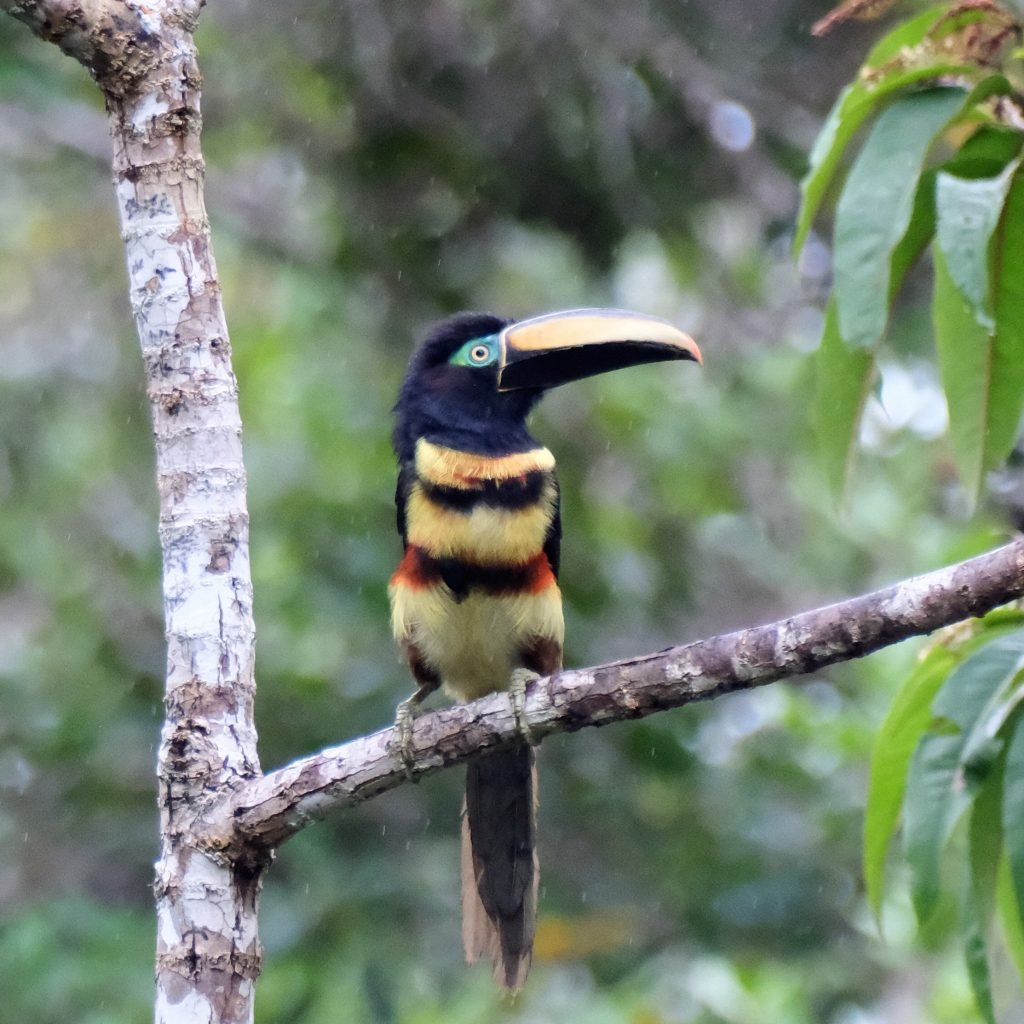
Our territory sits in one of the most biodiverse places on Earth: over 500 bird species, more than 130 reptiles and amphibians, 165 mammals including ten primate species and Amazon pink river dolphins, and upwards of 10,000 plants. On a typical week guests see several kinds of monkey, pink river dolphins many times over, caimans on night outings, toucans, macaws, parrots, hoatzins, kingfishers, raptors, frogs in extraordinary variety, giant trees and medicinal plants explained by guides who grew up using them.
What no honest operator can do is guarantee a specific animal — a jaguar, a harpy eagle, an anaconda, a bushmaster. Wild animals do not keep appointments. What we can promise is that we take you where the odds are genuinely good: far past where day tourism reaches, with guides who spot in seconds what you would walk past for a lifetime. Bring binoculars — they change the trip entirely.
Lightweight quick-dry long-sleeved shirts and trousers, a light rain jacket, a wide-brimmed hat, river sandals for the canoe and around camp, several pairs of long light socks, a swimsuit, high-SPF biodegradable sunscreen, insect repellent, a refillable water bottle, a rechargeable headlamp (or spare batteries), binoculars, a dry bag for cameras and phones, a small personal first-aid kit with any prescription medication, and some cash in US dollars in small notes for tips and community crafts. We provide rubber boots, ponchos, tents and life jackets.
Pack into one soft duffel of no more than 15 kg — hard suitcases are impractical in a canoe, though if it is all you have we will make it work. On booking we send a full packing list tailored to your specific expedition and season. If you would rather travel light, you can pay a small extra to have a community member hand-wash your laundry.
Years Exploring the Amazon
Happy Travelers Guided
An experience that changed my life. Our guide knew every bird call, every plant. I have never felt so connected to nature. The lodge was beautiful, and the food was exceptional.
The herpetology tour exceeded every expectation. We documented over 40 species of amphibians in one week. The research methodology was rigorous, and the team was world-class.
Travelling with my two teenagers, I was worried about safety. The team was incredibly professional. My kids still talk about the night hike and the bioluminescent fungi we discovered.
I am a solo female traveller and felt completely at ease the entire trip. The Kichwa community welcomed me like family. I left with a full heart and a promise to return.
Our team of Ecuador-based travel specialists is ready to help. Reach out via WhatsApp, email, or the contact form — we typically respond within a few hours.
Get in Touch